Radon Mitigation, Without the Runaround
Residential radon mitigation and existing-system service across the south and southwest suburbs.
Serving Tinley Park, Lincoln-Way, Orland and Palos, Lemont, Homer Glen, Lockport, Crest Hill, Shorewood, and nearby communities.
State-licensed radon mitigation backed by more than 10,000 installed systems and 700+ Google reviews with a 5.0 average.
Got a Result, a Closing Date, or a Weird Fan? Call Us.
Give us a call or send your information over. We will talk through what you know, what kind of foundation your home has, and what the next step should be.
Looking at your home tells us how your system should be laid out. If you are still figuring out testing, start with our testing guidance or just call us.
Trying to understand budget ranges first? Read our radon mitigation cost guide.
Radon Mitigation Installation
State-licensed radon mitigation for homes with basements, crawl spaces, or slab foundations, plus real-estate timelines. Bill personally evaluates your home before your system is designed and quoted. We plan the pipe route and fan location around your foundation and living space.
What’s included
- Sub-slab depressurization (SSD)
- Block wall suction systems
- Crawl-space vapor barrier and sub-membrane suction when needed
- Sump pump integration
- System monitoring with U-tube manometer
- Post-install verification test referral
- Five-year complete fan replacement coverage
Anyone hired to install an Illinois radon mitigation system must be appropriately state licensed. A resident working on the dwelling where that person lives is exempt from the state radon-license requirement. American Radon Systems holds Illinois Radon Mitigation License RNM2018212.
Radon Fan Replacement
A fan that becomes noticeably louder, rattles, grinds, hums, or sends vibration through the wall may be wearing out or may have another system issue that should be checked. A properly working radon fan is not perfectly silent. Most produce a soft, steady sound of air moving through the pipe. If the system becomes completely silent, check the U-tube manometer to see whether suction is still present. We can typically come out the same day or the next day in most cases.
What’s included
- Same-day or next-day fan replacement in most cases
- Full-system check, not just the fan
- Five-year complete fan replacement coverage
- Pipe sealing and radon system repairs
- Text us your town and a clear photo of the fan and manometer
If a fan we install fails during the first five years, we replace it at no cost to you. The service visit, labor, and replacement fan are all included.
Passive Radon System Activation
Already have a radon pipe but no fan? Many passive systems can be activated after a high test. Bill can inspect the route, confirm whether the piping is usable, add the right fan, and make sure the activated system is pulling correctly.
What’s included
- Passive pipe inspection
- Fan sizing and installation
- Discharge and routing check
- Manometer setup
- Existing pipe evaluation
- Clear next-step guidance
System Relocation & Pipe Rerouting
An existing radon system does not always need to be torn out and started over. Bill looks at your existing system, your home, and your remodeling plan before recommending what should move, what can stay, and what can be reused.
What’s included
- Interior and exterior pipe rerouting
- Fan relocation
- Full system relocation when needed
- System redesign around living space
- Usable component evaluation
We do not assume every system needs to be replaced. Not every system can be moved, and not every component can be reused.
Radon System Inspection
Not sure if an existing system is working? We can check the fan, manometer, pipe route, sump lid, and obvious suction issues, then tell you honestly whether anything needs repair or replacement.
What’s included
- Fan and manometer check
- Visible pipe review
- Sump lid and seal review
- Repair or replacement guidance
- Clear next-step guidance on testing if needed
A checkup looks at the system hardware. A radon test is still how you know the indoor level.
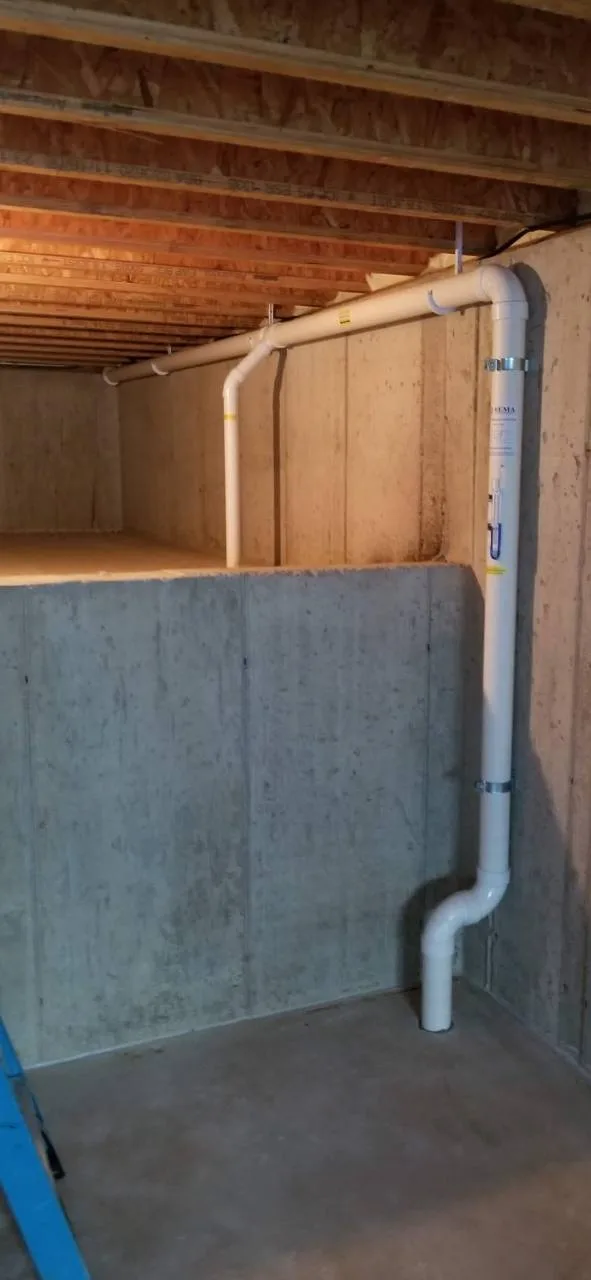
From our work
Basement routing in a Naperville home
A look at piping from one of our installations in Naperville, routed along the basement wall below the floor joists.
Experience with the way suburban homes are actually built
Radon systems are not designed from a single template. A finished basement needs a different route than an open utility room. A basement and attached crawl space require separate suction areas. Additions, split levels, slabs, walkouts, lookouts, passive piping, and existing systems all change the plan. Bill evaluates those details before the system is quoted.
A basement and an attached crawl space require separate suction points or suction areas. The design decision is how those components are routed and connected, not whether the crawl space can be ignored.
In finished or higher-detail homes, routing, paint color, fan placement, sound, and the view from the street may carry extra weight. Those considerations can be addressed during the design instead of after the system is installed.
Something else? See everything we handle or how an install works.
Have Your Test Result?
Send your result and town. Buying or selling? Include your closing date so we can talk through the next steps and available timing.
Not sure where to start? Not sure? Start Here → · Buying or selling with radon · Realtor paths
Mitigation Questions, Straight Answers
What the system is, how long install takes, what it costs, the warranty, licensing, sump sealing, and whether we test (we do not sell testing).
How does radon get into a house?
Pressure under the home can pull soil gas up through porous concrete, sump openings, crawl spaces, cracks, seams, and small gaps around pipes. It is usually not one single hole. That is why systems are designed around the whole foundation, not just a visible crack.
Is radon fixable?
Yes. Elevated radon is a common, fixable home issue. A properly designed mitigation system creates a lower-pressure path under the home so soil gas is pulled into a pipe and vented outside. Most installs are finished in one visit after Bill has looked at the home.
Does American Radon Systems test for radon?
No. American Radon Systems specializes in mitigation. Illinois licenses testing and mitigation separately, and testing is handled by licensed measurement professionals. EPA also points out the conflict of interest when the same company tests a home and then sells the fix, so keeping the two apart is deliberate. Bill can help you understand a result and point you toward the right next step. If you already have elevated results, send them over with your address.
What is a radon mitigation system and how does it work?
Most homes use sub-slab depressurization: a fan and pipe pull soil gas from under the foundation and vent it outside above the roofline or in a code-compliant location. A U-tube manometer on the pipe shows the fan is creating suction. The exact layout depends on basements, crawl spaces, slabs, sumps, and finished spaces. Bill designs for the home you have, not a one-size layout.
How long does a typical radon mitigation install take?
Most residential installs are completed in a single visit, often a few hours once the plan is set. Bill looks at the home first so materials and routing are right. Real estate closings get scheduled around the calendar when you tell us the date early.
Does the radon fan run all the time?
Yes. A healthy mitigation fan runs continuously, and it should not be switched off in winter or while you are away. Whenever it is off, soil gas has its normal path back into the house, and the system gives no protection until it is running again. In our experience, running it year-round adds roughly $60 to $125 a year to the electric bill, depending on the fan and your rate. A light steady hum can be normal. If it gets loud, rattles, or goes silent, call Bill; that is a service call, not a switch.
Can you mitigate basements, crawl spaces, and slab homes?
Yes. Many Illinois homes need more than one suction point, especially split-levels and three-step ranches with a basement plus crawl space. Slab homes get their own approach. The goal is every foundation area covered and a clean pipe route that looks like it belongs.
Is sealing the sump necessary for radon mitigation?
Often yes. An open sump is a common soil-gas path. We typically seal the sump with a lid that still allows pump service and access. Sealing alone is not a full mitigation system, but a proper lid is usually part of a good design when a sump is present.
Will the exterior pipe look bad on my house?
We plan routing carefully. Where the layout allows, pipe may go through a garage attic or interior chase and out the roof. When the cleanest path is outside, it goes on a side or rear elevation and is finished to read more like a downspout than a mistake on the front of the home.
How much does radon mitigation cost?
Passive system activation starts at $900. A full new system runs $2,000 to $2,500 for most homes. A few homes need much more, up to $4,000 to $6,500 for a gravel crawlspace that has to be sealed or a home with more than one foundation type. Fan replacement on an existing system is $575. Bill looks at the home first, then gives you the price before work starts, and that number does not change unless you change the job. See our cost page for what moves the number.
What is your warranty?
If a fan we install fails during the first five years, we replace it at no cost to the homeowner. The service visit, labor, and replacement fan are all included. A replacement fan installed under warranty receives its own five-year term. Ordinary fan replacement outside warranty is $575, including the fan, the visit, the labor, and a new five-year term. No trip charge. Details, including transferability, are in your customer packet after install.
Why does my newer home have a radon pipe but no fan?
That is usually a passive radon system: rough-in piping that Illinois has required in new residential construction since June 1, 2013, under the Radon Resistant Construction Act. It is not the same as a completed active system. If a test is elevated, activation adds the right fan and finishes the system so it pulls correctly. Bill checks whether the existing pipe is usable first.
Are you state licensed in Illinois?
Yes. American Radon Systems holds Illinois radon mitigation license RNM2018212. Anyone hired to perform radon mitigation in Illinois must be appropriately state licensed. Illinois exempts a person doing measurement or mitigation in the dwelling where that person resides. Measurement and mitigation are separate professional license categories; American Radon Systems provides mitigation, not testing.
Can I do radon mitigation myself?
Illinois exempts a person doing radon mitigation in the dwelling where that person resides from the state radon-license requirement. That exemption does not make a mitigation system simple or risk-free. Proper suction design, combustion and electrical safety, sealing, discharge placement, local codes, and post-mitigation testing all matter. American Radon Systems recommends using a licensed professional for a compliant, documented system and does not present DIY work as equivalent to a professional installation.
Are you insured?
Yes. American Radon Systems is fully insured, including general liability and workers compensation, and performs mitigation under Illinois radon mitigation license RNM2018212. If an HOA, lender, or property manager needs insurance paperwork, mention it when you call; Colleen handles insurance requirements and HOA coordination.
Can I just seal the cracks and the sump instead of installing a system?
Sealing by itself is not a fix. Illinois guidance does not recommend sealing alone because it has not been shown to lower radon levels significantly or consistently; soil gas finds the next opening. Sealing matters as part of an active system, where the sump lid and openings are closed so the fan’s suction stays under the slab instead of pulling room air.
Why would my home need more than one suction point?
Because the fan’s suction has to reach every part of the foundation that touches soil. A basement and an attached crawl space need separate suction points or suction areas, and a large, sectioned, or extra-thick slab can need a second point to pull evenly across it. Bill looks at those details before the system is designed and quoted, and the runs tie into one system with one fan wherever the layout allows.
Do you guarantee the radon level will come down?
Yes. If your post-mitigation test is still 4.0 pCi/L or higher, we come back and do the additional work at no charge to you, and we pay for the professional retest afterward. That is the guarantee on the standard systems that make up nearly all of our work, and Illinois requires it to be spelled out in the written proposal you accept before we start. Your proposal is the place to read the exact terms for your home.